I had met JoelG in 2006, shortly after moving back to the Bay Area from Hawaii. We had both been wrapped into a friends documentary about Canyoneering and ended up taking over production on the documentary a couple years later to do the final edit, mix and post-production.
In 2010 he approached me about doing a collaboration together. He’d been photographing all around San Francisco and was wondering if I wanted to put it to a soundscape. Of course I jumped at the opportunity. Beyond bands, I hadn’t done much artistic collaboration , and this sounded fun.
He started sharing his images and some rough cuts of parts and we discussed what I could bring to the project. I composed to the images and it was very much a composition-by-feel kind of piece.
It debuted at the Donner Art Gallery in Oakland, CA in November of 2010, and I recently found a cut I had on my machine, so figured I’d share it here
When given a chance to talk about our Foley system in Ghost of Yōtei, you will undoubtedly hear me gush and rave incessantly and claim it’s the first time I’ve ever really enjoyed tagging animations. All these things are absolutely true. Josh Lord, who architected the new system, talked about it at our talk at GameSoundCon 2025, but I wanted to go into a bit of detail about the system and a few cool features that we added to really make things sound great.
For a deeper dive into the nuts and bolts of the in-game system, I’ll hopefully be able to post a version of that talk up here after we present it to the Seattle Game Audio Group in April.
You Scream? I Scream!
One of the earliest, and arguably biggest, changes for audio on Ghost of Yōtei, was switching our audio middleware from Wwise to Scream. Scream is an internal Playstation audio tool used by several studios including Naughty Dog, San Diego Studio, and Bend, (Guerilla also uses the low-level synth to power their engine in Decima). I absolutely love Wwise, and our reasons for switching were numerous, but one thing I’ve always appreciated about Scream since using it for the first time in 2005, is the ability to write scripts directly in your sounds (an “event” in Wwise is called a “sound” in Scream, with the contents of those sounds being waveforms and/or streams and optional logic).
Scream lets you write fairly complex scripts with a simple drag and drop interface. They provide around 40 or 50 grains: single line commands that let you do most sound manipulation from playing a sound or a random set of sounds, to executing branching based or conditional logic driven by variables (floating point values like RTPCs) or registers (integer values like Wwise Switches (local registers) or States (global registers)). Variables and Registers can be set from your game engine or directly from Scream. This opens up an insane amount of power and flexibility to sound designers, with little to no actual scripting needed.
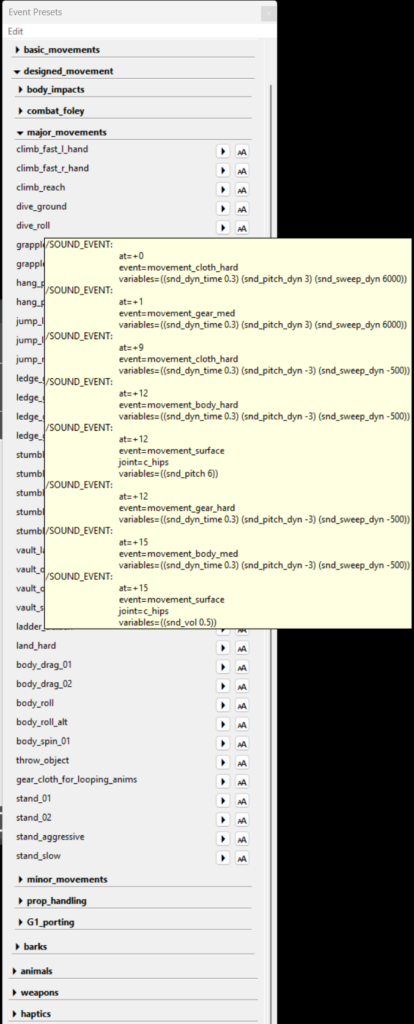
Our entire cloth and gear system for characters involves just 10 sounds each: cloth soft, med, and hard, gear soft, med, and hard, body soft, med, and hard and a surface layer. We use these 10 sounds coupled with a powerful variable-driven system in Scream to effectively spot foley in our engine in real-time. So we place these individual sounds and then affect each instance by tweaking its variables such as volume, pitch, seek, envelopes, randomization, filter sweeps, distortion, etc.
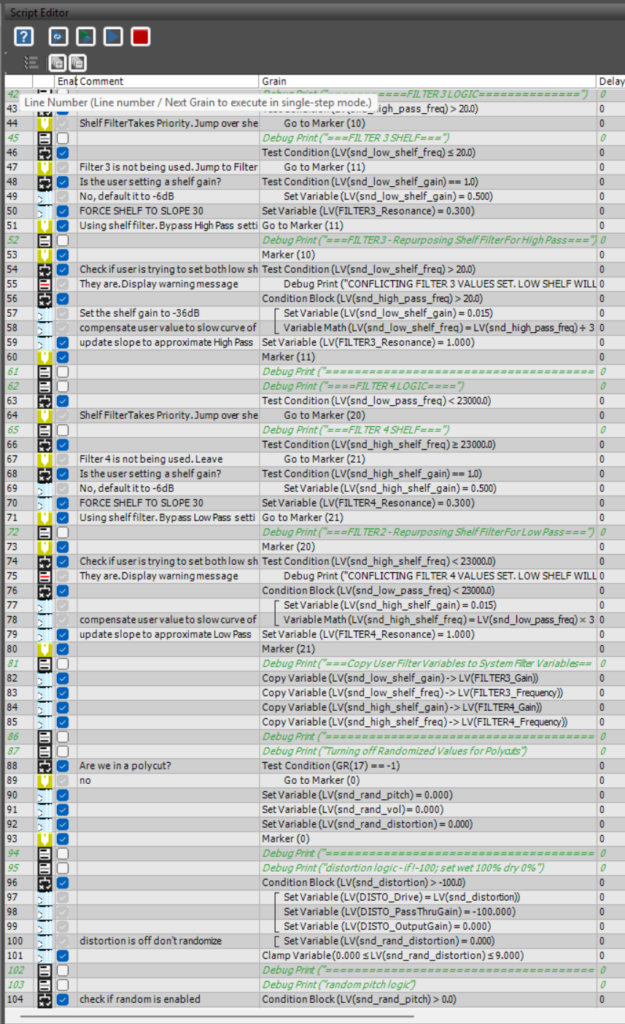
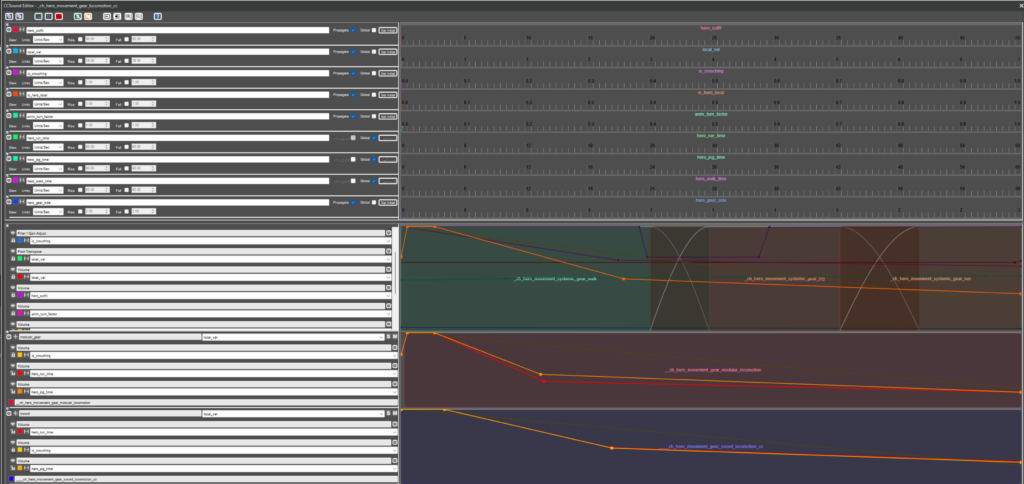
The beauty of Scream is that Josh wrote a single utility script that handles all of this variable logic and in each of our characters’ cloth and gear sounds. We just branch to that script and the sound sucks in all of the logic for controlling these parameters based on the variables we have set up in our engine.
Here’s what some of that looks like in Scream:
Authoring itself isn’t necessarily just dropping a bunch of these 10 sounds and adjusting parameters every time. Instead, we’ve built up a library of presets for common actions, so we can drop a preset on the animation timeline and it will add all of the sounds and their respective variable settings across the timeline.
Once you drop a preset, then it’s just a matter of some light massaging to make sure the sounds match the animation perfectly. It really is a fun iteration loop! Let’s take a look as some of the other cool features this system has afforded us.
Footstep Blending
Once we built the utility script for our cloth and gear, we started realizing we could use it across other sounds or even write variations on it for specific sounds. Footsteps and hands were a logical extension of where to use these and we quickly adopted the same set up for our footsteps. But then we had a crazy idea: when walking or running across surfaces, the change between surfaces is always so rigid. One footstep is snow, the next is stone. What if, when the surface changed, we could crossfade the two surfaces over the next several footsteps, effectively blending the surfaces?
Josh quickly wrote another script in Scream to do just that. It gets the current surface material, stores it out as the previous and when it changes, crossfade between the previous and current over a few steps. It’s such a subtle add, but we were blown away at how good, and natural, and detailed it helped the world sound instantly.
There were a few surfaces, where it just didn’t make sense or sound good to blend, like going from wood to any surface or ice to water, and it was VERY easy to add those exceptions into our scripted sound in Scream.
Gear on Back
This is actually something we had on Ghost of Tsushima, but on Tsushima the only thing that was ever on Jin’s back was his bow and quiver. We built a dynamic arrow system so that the amount of arrows the player would hear in the foley changed based on the amount he had in the quiver, but that was the whole system.
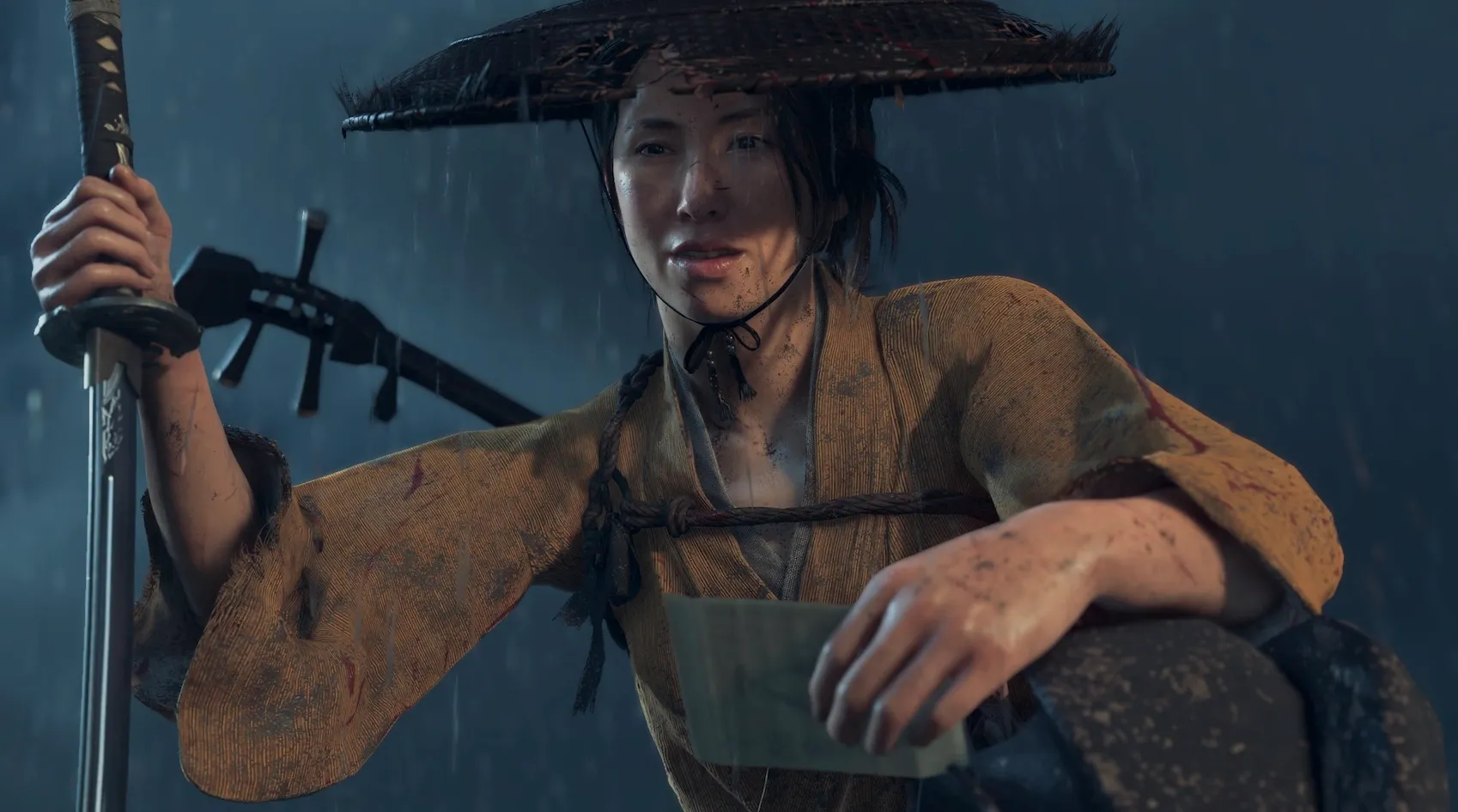
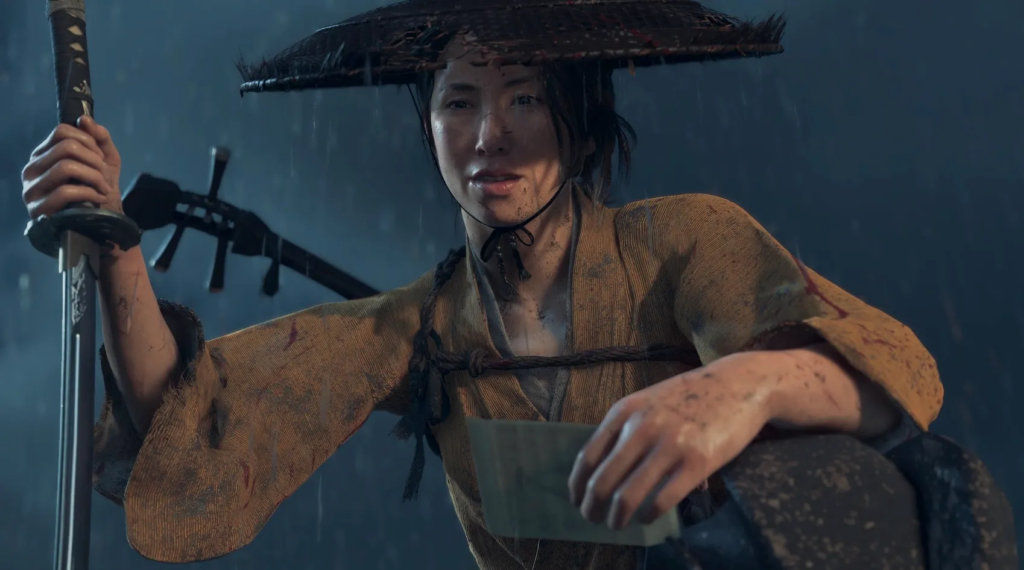
For Ghost of Yōtei, Atsu could have A LOT of different things on her back: her shamisen, bow and quiver, kusarigama, odachi, or tanegashima (rifle). We thought it’d be cool to give her a little flavor by adding these subtle sounds to the gear based on what was visible at any given time, and again Scream’s scripting and variables allowed us to do this relatively quickly and easily.
We carried over the dynamic quiver from Tsushima, and then we started with the shamisen. I’d bought a shamisen at a Japanese arts market and we recorded the hell out of it. Josh then built some movement sounds to match our soft, med, and hard paradigm with regards to file lengths and transients. We put it in, and Atsu instantly had a very special, unique character that only the resonance of her shamisen could provide. After that, Chris Walasek designed assets for the remaining weapons and we rigged them up, tweaking the probability so it plays often, but not always in a cadence that matches the animation.
I love it especially because it’s super subtle so you usually don’t notice it, unless you mute it or turn the gear off on the back. But occasionally the resonance of the shamisen, or the rattle of the kusarigama, or the weight of the odachi pops through the mix just a bit and makes Atsu feel more grounded in the world
Mixing over time
Another feature we kept from Tsushima and improved upon was our time-based mixing of foley. Effectively we kept track of how long a player was walking, jogging, or running and would mix down cloth and gear layers over time based on the elapsed time of the action. Once the player stopped moving, or changed speeds, say, from a run to a jog, we reset the clock. The end result was a very subtle means to mix down layers of foley that could grow fatiguing if they continued to play at full volume.
We also extended this to the hero horse, and would turn down the footsteps, saddle, and bridle sounds over time to provide a transparent means to reduce ear fatigue, especially when galloping across long swaths of the map. This is what that looked like in Scream for a hero gear layer. In this instance the player doesn’t walk very often or for very long, so we opted to only tweak for jog and run.
A Very Special Guest
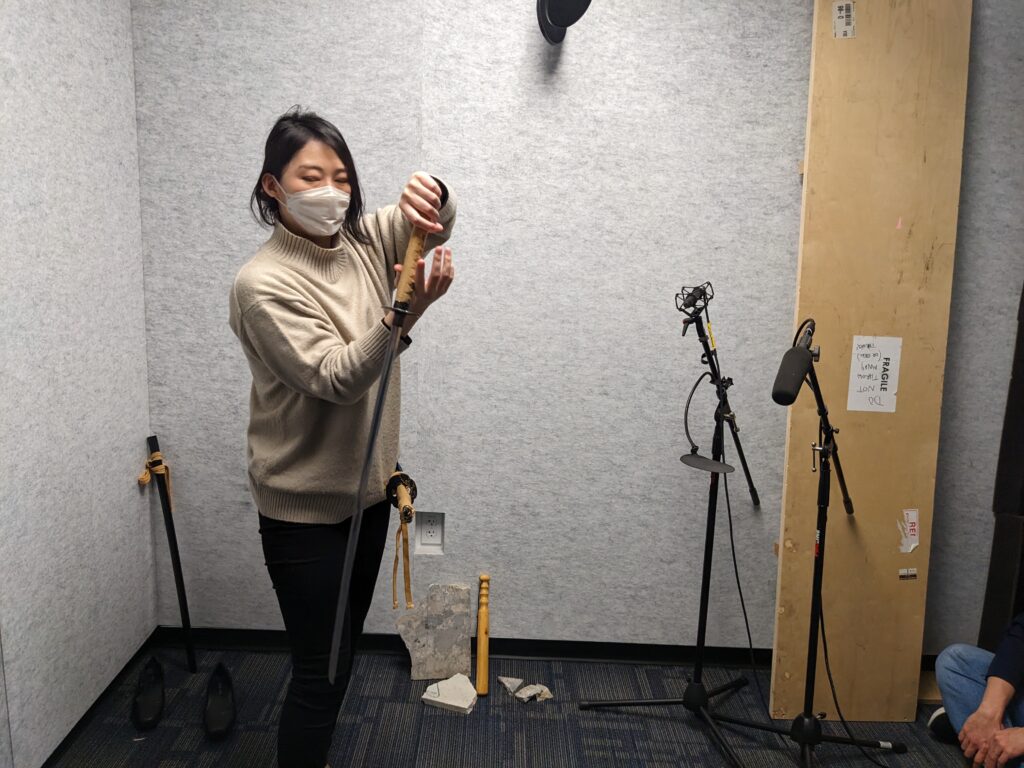
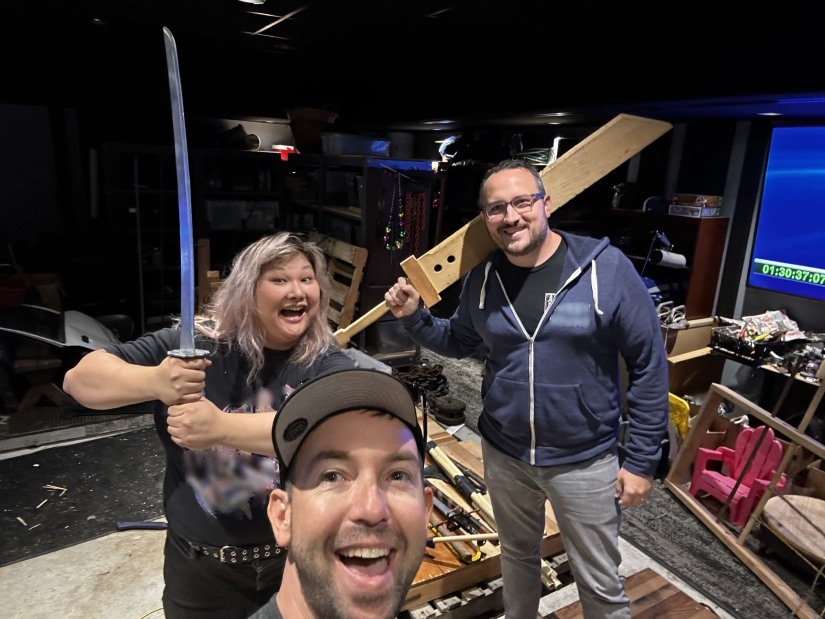
We were also lucky enough to work with Tenshin-ryu, a school for Japanese swordsmanship in Tokyo. They flew out to Sucker Punch in 2023 and, while most of their time was spent in the mo-cap volume capturing moves for Atsu, I was lucky enough to get some time with Rensei, one of their amazing martial artists. She came into the foley room and we recorded a ton of various swings, sheathing, unsheathing and chiburi (cleaning the blood off the blade) moves. The swings didn’t really work for our needs, but much of the sheathing and unsheathing sounds ended up as elements in Atsu’s sheathing and unsheathing in game. The best part was that Rensei’s swords had a very unique sound to them in that they rattled slightly as she used them, and this helped give Atsu’s katana a very unique sound, while still staying true to real sound of a katana.
The Glue that Binds
That covers most of the mechanical features and improvements for Foley in Ghost of Yōtei. The other improvement came in the form of Joanna Fang and Blake Collins, PlayStation’s indomitable Foley team. We worked very closely with Joanna and Blake to capture most of the character foley in game including footsteps, all character gear and foley, combat swings and impacts, and even our horse footsteps, which we concocted from toilet plungers stuffed with cloth and a wood shim taped to the end to give a little clop.
Here’s a video that may seem rudimentary, but was used to educate the team in a company meeting back in 2023 , fairly early in production of Yōtei (which as you may notice was codenamed “Wanderer” at the time), about what a Foley team does:
Ambience is such a crucial part of what makes a Ghost game a Ghost game: it provides a time machine for the player, whisking them back to a believable version of feudal Japan. On both Ghost games, we had Sucker Punch trips to Japan. Although no audio people went on those trips, I always gave a recorder to someone on each trip, and they invariably returned with usable content. In addition, I was able to travel on my own to capture as much natural sound as I could. Over New Years in December and January of 2016/2017 I made a very calculated 10 day trip to Japan to record very specific species for Ghost of Tsushima, and I knew I needed to go back for Ghost of Yо̄tei (poor me).
Back to Japan
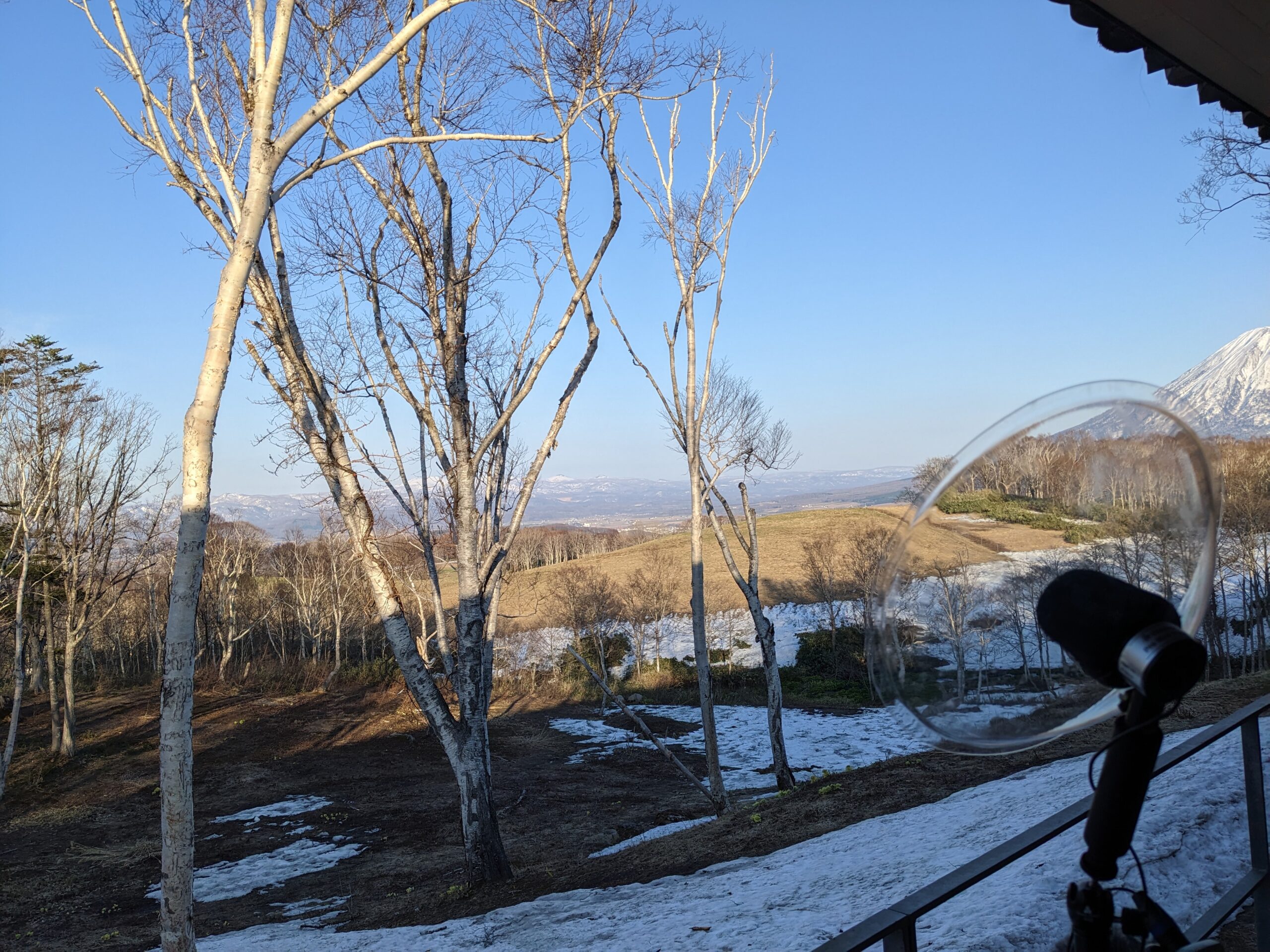
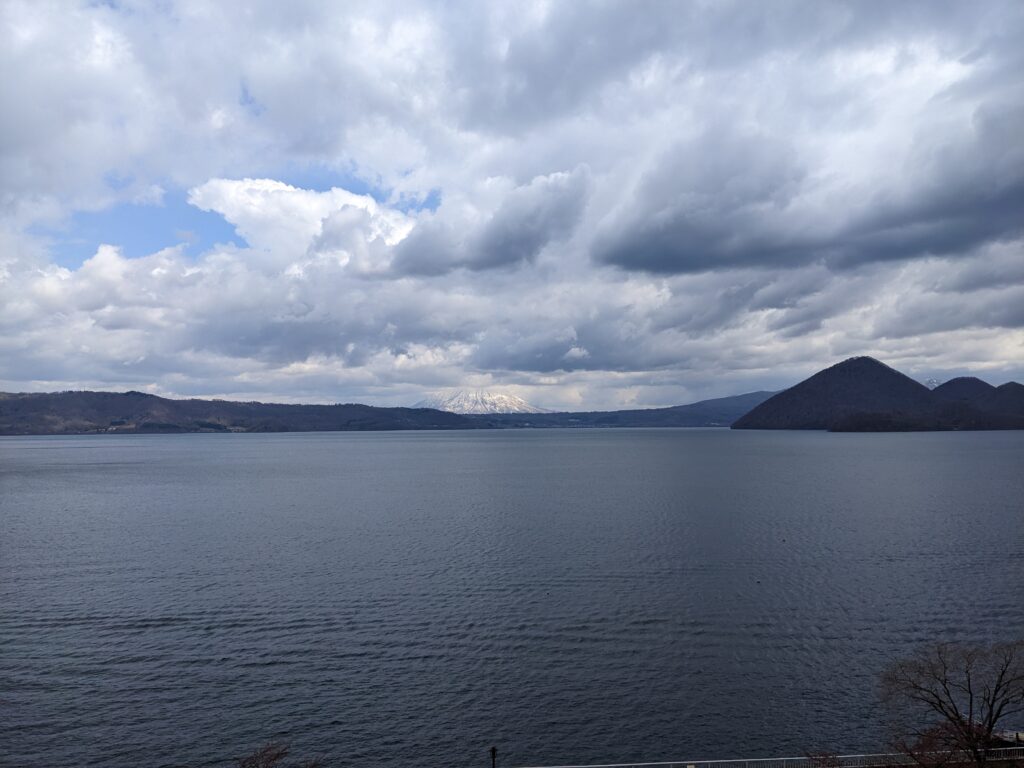
In April of 2023, I was lucky enough to travel to back to Japan, focusing mostly in Hokkaido, and spent about 10 days traveling around Mount Yotei (seen to the right in the picture above), spending time around Kutchan, Lake Toya, Lake Shikotsu and also spending a day at Noboribetsu, famous for its sulfur pots and the inspiration for Saito’s fortress at the end of the game.
I wanted to keep my load light, so brought lots of smaller microphones (Usi Pros, Micbooster Pluggys, and a Sennheiser MKH8060), and small parabolic dish, and a Zoom F3 and Sound Devices MixPre6. I went with a few friends, so I would often hike out somewhere for a half day and meet up with them later.
We also spent a little time in Kyoto and the Seto Inland Sea, so I got a lot of nice recordings there as well. The Japanese Bush Warblers were so prolific around Honshu, I couldn’t believe how frequently I was able to capture that iconic chirp.
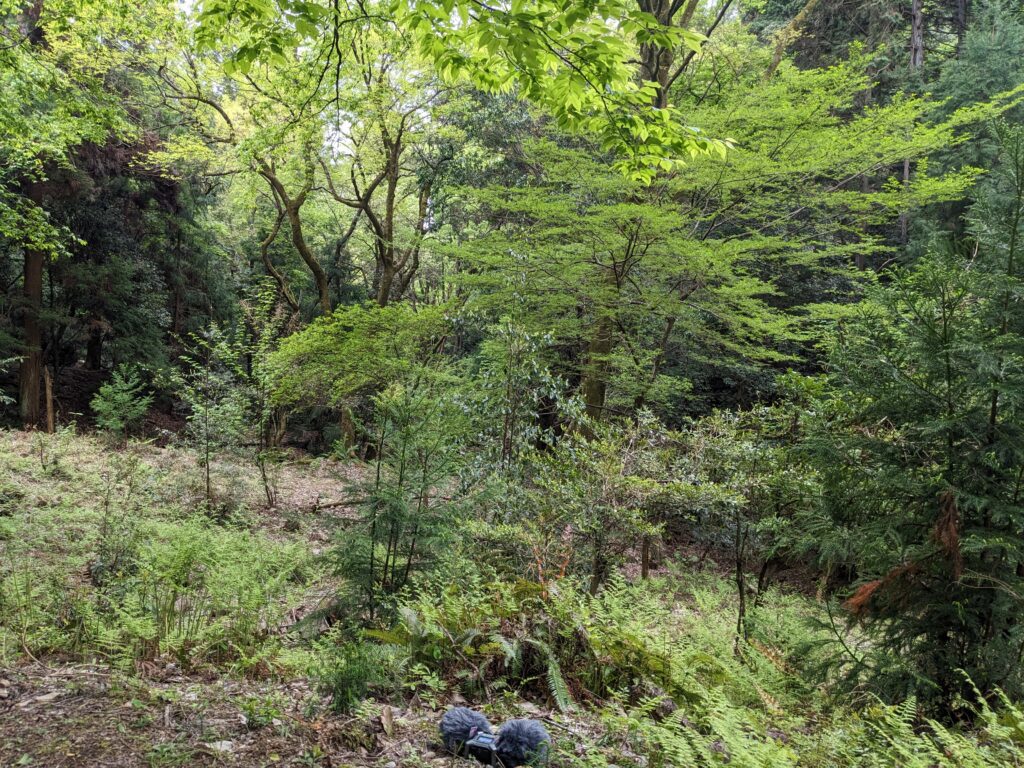
Here’s a recording from Mount Daimonji near Kyoto. Very little processing done beyond cleaning the recording up:
Hokkaido Bound
I was fortunate to travel to Hokkaido on my first trip to Japan in 2016, heading over to the eastern side to Kushiro and Lake Kusharo to record red-crowned cranes and whooper swans, and immediately fell in love with the island.
Hokkaido is such an amazing place and, other than Sapporo, feels so much more remote than much of Japan, as it’s relatively sparsely populated for its size, and awash in amazing natural beauty. I got so much incredible content on our trip in 2023, that I was able to replace most of our birds from Ghost of Tsushima with wholly new ones. Beyond the Bush Warblers in Hokkaido, one of my favorite species I captured were some Great Woodpeckers (both drumming and calling) around Lake Toya and Kutchan. Here’s some drumming from Kutchan:
And then there was the Latham’s Snipe. We had just arrived at Lake Toya as the sun was setting. We had what seemed like a nice Air BnB on a hill overlooking the lake. Unfortunately, the house reeked of gas, so as we were airing it out, I set up a recorder on the front deck and this crazy, creepy sound started happening. I had to post it on xeno-canto when I got home just to identify what the heck it was:
Of course, not everything I recorded was birds, and not everything I recorded ended up in game. In Noboribetsu, a town famous for its sulfuric lakes, I was fortunate enough to record the geyser at Sengen Park, which only goes off every three hours. Super cool sound, but nowhere that really made sense to include it in the game
recording a steam vent. Sounds cool didn’t end up in the game.
Sound Scenes
Beyond our normal biome-based ambience, we also built a new system for Ghost of Yōtei to more procedurally handle smaller-scale ambiences that we previously hand-placed throughout missions and in various locations, like buildings and villages. The contents of these recordings were more akin to the small things in a scene or place that make it feel alive. Distant bells ringing, shoji screens banging, distant barrels rolling, wood dropping, horses neighing, etc.
We recorded a bunch of source at Sucker Punch and even more down in San Diego with Joanna Fang and Blake Collins. Josh went down and the three of them essentially combed through the foley room grabbing random props and proceeded to shake, slam, drop or bow them to create a huge palette of sounds we could use for our various scenes in the game whether it was a boisterous inn, a bustling village, a ghost town, a rickety bridge, or a weathered shrine climb.
We then processed the source in three different ways: dry, which was used when the player was near where the sounds would play from, and then a mid distance and far perspective version that used reverb, EQ, and some delay to push the perspective into the distance.
The system in our engine would then play these sounds back from random positions within volumes that we authored in the game world. So rather than having to hand place dozens or hundreds or emitters. We just dropped a volume and assigned that volume a number of scenes that would play out in the volume based on distance from the listener.
Our goal with the ambience in Ghost of Yо̄tei was to improve upon the natural audio beauty we built with Ghost of Tsushima, but also provide more dynamic behavior, more movement and more life. I believe we accomplished this, and I cannot express how fortunate I feel to have been able to to travel– twice!– to Japan to not just record nature sounds but breathe in the natural world. Hearing how a space sounds, the natural pauses, the inherent silences, the unexpected tones, coupled with the visuals, the smells, the presence of being in the space is transformative and crucial in trying to really capture the sense of place.
I love to travel, I love to record, and I truly hope I get to return to Japan again some day and record even more!
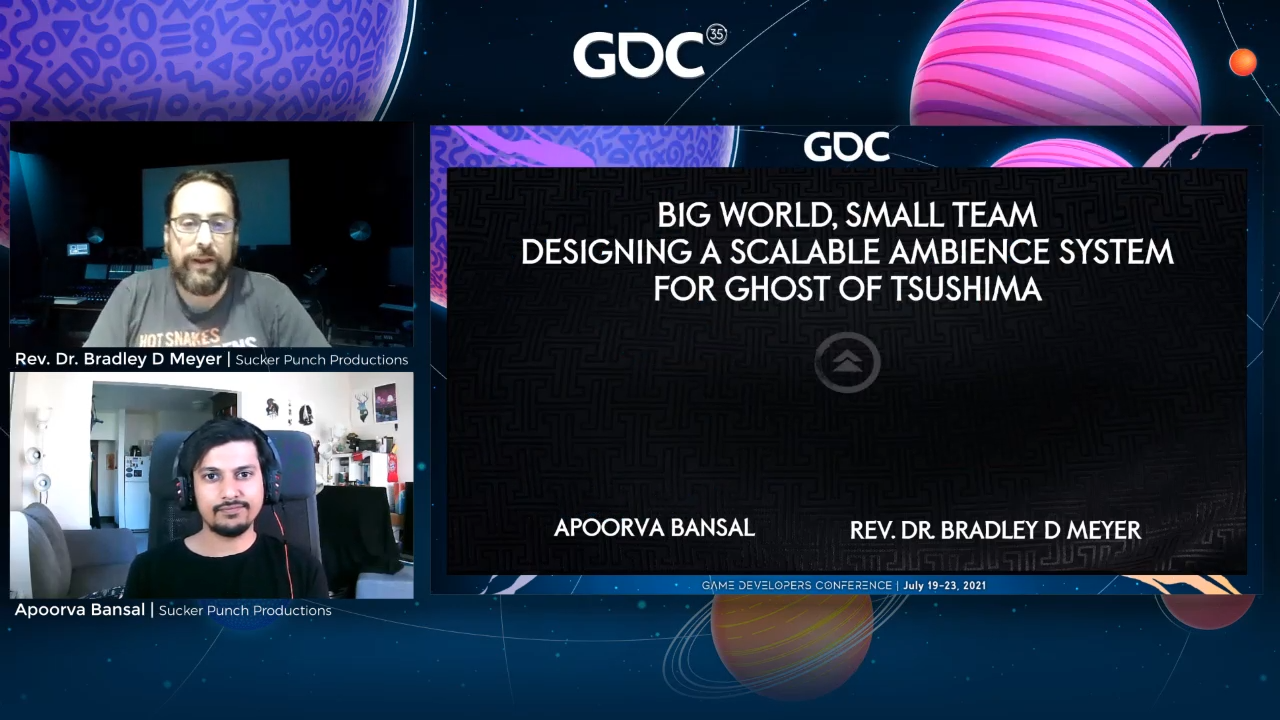
In March 2021, Apoorva Bansal and I gave a talk for GDC entitled “Big World, Small Team: Designing a Scalable Ambience System for Ghost of Tsushima.” The talk outlined the journey we took in developing the procedural ambience system we used and I hoped it would serve as a potential blueprint for other studios looking to build a robust, flexible ambient playback system that reduces the manual workload of hand-placing emitters in the world.
The talk was behind a paywall, as many talks are on GDCVault, but I noticed recently it’s now accessible as free content, so I wanted to share it in hopes of more people being able to learn from the successes we had.
GDC 2021 was a weird one because it was a fully remote GDC. We pre-recorded the talk and I was actually down at Playstation in San Mateo mixing the Director’s Cut of Tsushima at that time., while Apoorva was in his apartment. Then during the actual conference, we watched the stream and answered questions in the comments. It was a different time, and I’m so glad we’re back to in-person and hybrid conferences. Here’s the link to watch it on their site. Hope you enjoy!
Our lead sound designer, Josh Lord, and I are giving a talk at GameSoundCon this year about some of the audio system improvements we crafted for Ghost of Yōtei. I’m really excited about this talk and am so proud of these systems that the team built. Our foley system in particular is something that is revolutionary (to me) because it simplifies the assets required, gives designers more creative freedom in the engine, AND somehow makes animation tagging fun.
We’ll be speaking about that, our location-based ambience, combat and waterways. All of which demonstrate an evolution in our systems and process to make the world of Ghost of Yōtei more nuanced and detailed than its predecessor while entailing less manual work for sound designers.
The talk will be taking place on October 29th at 4:15pm in Academy 3 at the Burbank Marriott Convention Center
On October 15th 2025 our composer Toma Otowa and I joined Erika Ishii to discuss and listen to some of the tracks from the soundtrack of Ghost of Yotei. It was really fun to get to discuss some of the tracks and listen to them with a small audience. Jason Connell, one of our creative directors was supposed to be there as well, but unfortunately was sick. Toma is such an easy guy to chat with that we easily could have spent another few hours talking about the music and sharing anecdotes. Hope folks will join and enjoy what I think has turned out to be an exceptional soundtrack.
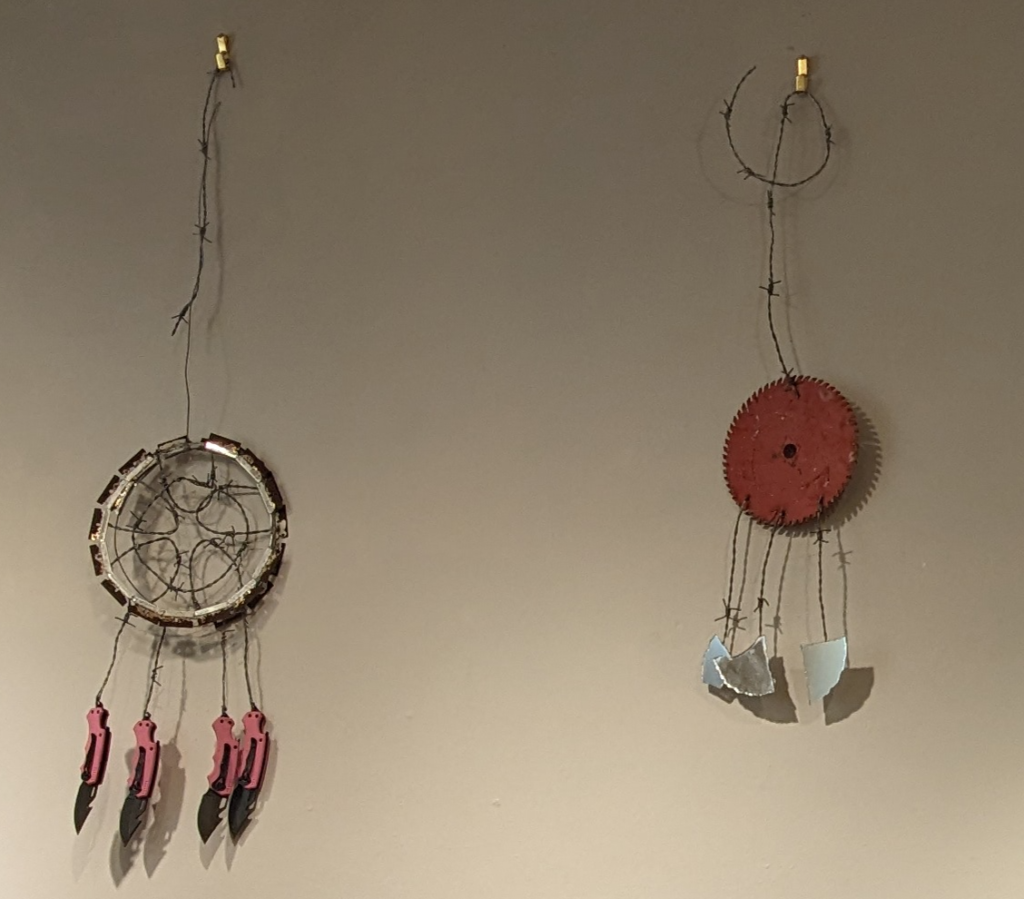
I was asked to join Lacuna Observatory, an artist collective a while back and we just had our first show exploring the spaces between dreams and the waking state. While I showcased a couple sculptures I created for the show, Dreamcrusher I and Dreamcrusher II, my main contributions were naturally on the audio side.
I had created a phone number where people could call in and leave recordings of their dreams. I then put the dreams onto a small AdaFruit sound board and installed that into an old rotary phone. And thus, the dream phone was born. Pick it up, and hear people’s dreams. It sat on an oilcloth with the text of the dreams laid out so that the dreams ran into each other, forming new images, much like they do when dreaming.
The first piece I did for the show, which is most relevant to audio, is called Vision through Sound. It examines the way our senses intermingle to create a perception of reality. Each scene begins with a soundscape, giving your brain time and space to create an image of what it hears. Text prompts appear on screen which will alter your brain’s perception in some way. Next, an image appears to cement or shift that reality. Finally, everything dissolves away, leaving just the audio to drift from your memory.
I recommend you give it a listen with headphones as several of the recordings were captured binaurally. Curious to hear how people perceive it and how they feel about the confluence of audio, word and image.
It was an exciting week for me and all of us at Sucker Punch, as we finally announced our new project. Ghost of Yotei to the world! I look forward to doing some deep dives into the new systems and sounds that we ‘ve built for this game. I’m so excited to share more soon!
I’ve long been a fan of Sam Hughes’ Sound Architect podcast. He always asks great questions and the results are informative discussions with very talented audio people. I was pleasantly surprised when he reached out asking if I’d like to chat with him about Ghost of Tsushima. It took a lot longer than either of us would have liked to set things up, but once we did, we had a really great chat. We went over the normal one hour time for his interviews and easily could have spoken for another hour or three. I hate the sound of my own voice and my penchant for interjections of “um,” “like,” and “you know,” but hopefully you’ll find it informative too.
More recently, I was asked by Alistair Hirst over at Dolby to talk with him about Ghost, so I got Adam Lidbetter, our supervising sound designer at Playstation, Andrew Buresh, our senior music editor, and Apoorva Bansal, who did most of the audio programming on Ghost to sit down and talk about the audio of Ghost and some of the fun challenges we dealt with. Here’s the result there:
Last one here, but worth a mention. I was contacted by Hamidreza Nikoofar, an Iranian sound designer, composer and podcaster. He has a podcast called Wassup Conversations and has hosted an impressive array of guests. We had a good chat about my career and Ghost and I highly recommend checking out Hamid’s other episodes.
[editor’s note: This was originally published here on June 9, 2021]. It’s hard to believe Ghost of Tsushima is almost a year old already! It came out on July 17, 2020. We started planning for the final mix in February of that same year. Do you remember February of 2020? The only people, at least in the U.S., that wore masks were superheroes, vaccines were for kids and traveling, and people felt totally comfortable crammed into enclosed spaces. With that mindset, we started planning. I would fly down to Sony San Mateo, other Sony sound folks would fly up from San Diego and Los Angeles and collectively we would spend a month packed into a studio mixing the game. I knew a month wouldn’t be enough to mix the game, but it’s all I could get. The thought of me being away from the office for that long was already daunting. The initial plan was for only 3 weeks, but I negotiated to 4. Because we weren’t going to have enough time, my strategy was to focus on what most players would experience: start with the core systemic gameplay, followed by the Golden Path missions, our main narrative, the special Legendary Item missions, and finish up with as many of the buddy chain Silver missions as we could get to. It was a solid plan.
As things got worse with the coronavirus, our mix plans became a bit more fluid. Maybe I could fly a small charter airline down to the Bay Area. Maybe we’d need to limit the number of people who came. Then the shelter-in-place orders came. Because the audio team needed special facilities to do our jobs we were initially given special consideration during this time. I kept working in the office with a skeleton crew of others, and there were a couple people at Sony doing the same. As the situation worsened, I was forced to move home, and our plans continued to change. We started floating every idea possible. Mixing at home was not ideal since I didn’t have a decent, quiet room. Would I need to seal myself off at work and mix alone in my non-calibrated studio? By early April things had solidified into what would promise to be the most unique mix experience I’d ever been a part of. I would drive down from Seattle to San Mateo (a 14 hour drive normally without traffic, yet only a 12 hour drive at peak pandemic time). I would stay in a hotel right across from the Sony campus. There would be one other member from each discipline joining me: Adam Lidbetter from sound design, Kyle Richards from dialogue, and Nick Mastroianni from the music team. Adam, Kyle, and myself would be situated a minimum of 10 feet apart from each other in Studio A, and Nick would be in the live room playing the game. It was not ideal, but it was a plan.
And surprisingly it worked exceptionally well. Part of the reason for that was that we asked the other folks who were supposed to be at the mix to play the game, and to play ahead of us. I maintained a google doc of mix notes, and every day as people played through they would add to the mix notes. The reason we had them play ahead of us was so we could address their notes as we made it through the game in the studio.
The unsung heroes of the entire pandemic were our IT department. They and a few programmers figured out how to get the entire studio and our proprietary toolchain working remotely in a matter of days. It was remarkable. Using this tech, I was able to download package builds from a devkit at the hotel I brought with me everyday and play them each night while I was in my hotel room ordering takeout and wearing a combination of N95 masks, bandannas and boxer shorts as facemasks (how far we’ve come).
About halfway through the mix we found out that our ship date was getting pushed slightly which gave us an extra week for mixing, which was a godsend. Somehow we managed to cover everything we’d planned in the initial 4 weeks, but that extra week gave us more time to polish and cover more of the game. We were so fortunate and that time really paid off.
I shot a ton of video while I was down there (though often not at the most opportune times), because I knew this was going to be a weird experience and such a strange mix process. The fact that it worked, and worked so well, is a testament to the entire team. The support I had from Sucker Punch and Sony was incredible and I still am in a daze over how lucky I’ve been to work with such a phenomenal team. So here’s a video showing some of the “highlights” of the mix. It’s long. It’s often boring. It’s sometimes funny. But it shows what the process of the mix really looked like, and I get honest about a lot of my personal and professional concerns, learnings and shortcomings. I don’t know that I would recommend watching it because it really is over a half hour of watching me talk with underwear covering my face or clicking a mouse in Wwise, but hopefully there will be some nuggets of interest to people getting a glimpse behind the curtain of a strange mix in a strange time.