Category: Sound Design

  • The Sound Design of Ghost of Yōtei: Character Foley

    When given a chance to talk about our Foley system in Ghost of Yōtei, you will undoubtedly hear me gush and rave incessantly and claim it’s the first time I’ve ever really enjoyed tagging animations. All these things are absolutely true. Josh Lord, who architected the new system, talked about it at our talk at GameSoundCon 2025, but I wanted to go into a bit of detail about the system and a few cool features that we added to really make things sound great.

    For a deeper dive into the nuts and bolts of the in-game system, I’ll hopefully be able to post a version of that talk up here after we present it to the Seattle Game Audio Group in April.

    You Scream? I Scream!

    One of the earliest, and arguably biggest, changes for audio on Ghost of Yōtei, was switching our audio middleware from Wwise to Scream. Scream is an internal Playstation audio tool used by several studios including Naughty Dog, San Diego Studio, and Bend, (Guerilla also uses the low-level synth to power their engine in Decima). I absolutely love Wwise, and our reasons for switching were numerous, but one thing I’ve always appreciated about Scream since using it for the first time in 2005, is the ability to write scripts directly in your sounds (an “event” in Wwise is called a “sound” in Scream, with the contents of those sounds being waveforms and/or streams and optional logic).

    Scream lets you write fairly complex scripts with a simple drag and drop interface. They provide around 40 or 50 grains: single line commands that let you do most sound manipulation from playing a sound or a random set of sounds, to executing branching based or conditional logic driven by variables (floating point values like RTPCs) or registers (integer values like Wwise Switches (local registers) or States (global registers)). Variables and Registers can be set from your game engine or directly from Scream. This opens up an insane amount of power and flexibility to sound designers, with little to no actual scripting needed.

    Our entire cloth and gear system for characters involves just 10 sounds each: cloth soft, med, and hard, gear soft, med, and hard, body soft, med, and hard and a surface layer. We use these 10 sounds coupled with a powerful variable-driven system in Scream to effectively spot foley in our engine in real-time. So we place these individual sounds and then affect each instance by tweaking its variables such as volume, pitch, seek, envelopes, randomization, filter sweeps, distortion, etc.

    The beauty of Scream is that Josh wrote a single utility script that handles all of this variable logic and in each of our characters’ cloth and gear sounds. We just branch to that script and the sound sucks in all of the logic for controlling these parameters based on the variables we have set up in our engine.

    Here’s what some of that looks like in Scream:
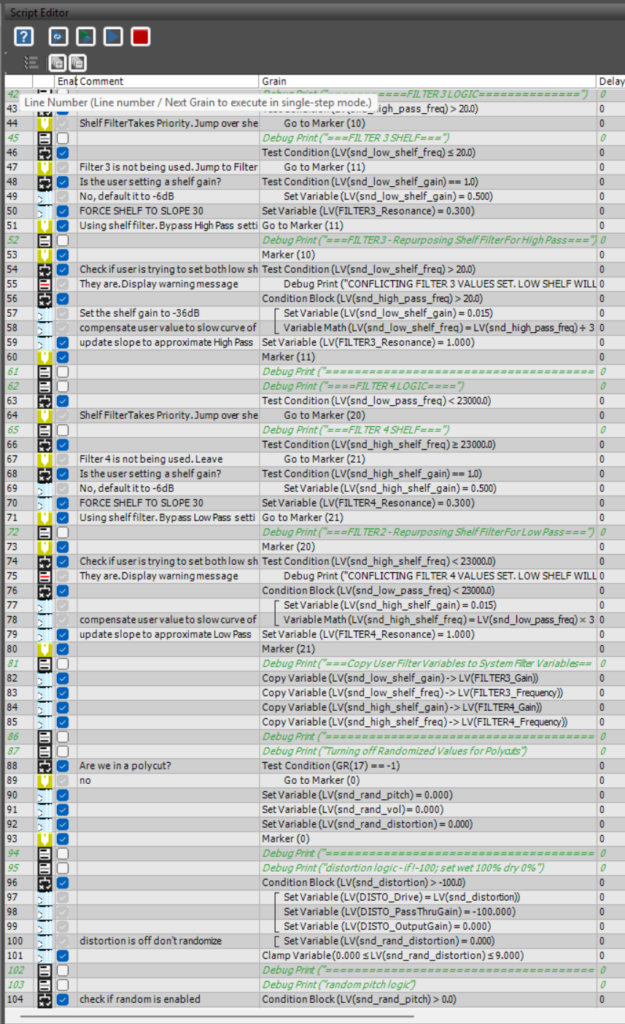
    a script setting various variables for a parent sound in Scream

    Authoring itself isn’t necessarily just dropping a bunch of these 10 sounds and adjusting parameters every time. Instead, we’ve built up a library of presets for common actions, so we can drop a preset on the animation timeline and it will add all of the sounds and their respective variable settings across the timeline.
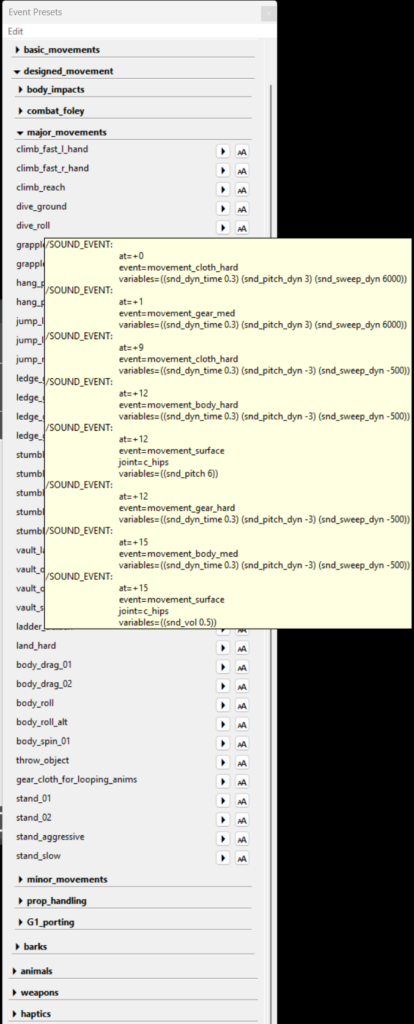
    an example of an animation event preset from our engine

    Once you drop a preset, then it’s just a matter of some light massaging to make sure the sounds match the animation perfectly. It really is a fun iteration loop! Let’s take a look as some of the other cool features this system has afforded us.

    Footstep Blending

    Once we built the utility script for our cloth and gear, we started realizing we could use it across other sounds or even write variations on it for specific sounds. Footsteps and hands were a logical extension of where to use these and we quickly adopted the same set up for our footsteps. But then we had a crazy idea: when walking or running across surfaces, the change between surfaces is always so rigid. One footstep is snow, the next is stone. What if, when the surface changed, we could crossfade the two surfaces over the next several footsteps, effectively blending the surfaces?

    Josh quickly wrote another script in Scream to do just that. It gets the current surface material, stores it out as the previous and when it changes, crossfade between the previous and current over a few steps. It’s such a subtle add, but we were blown away at how good, and natural, and detailed it helped the world sound instantly.

    There were a few surfaces, where it just didn’t make sense or sound good to blend, like going from wood to any surface or ice to water, and it was VERY easy to add those exceptions into our scripted sound in Scream.

    Gear on Back

    This is actually something we had on Ghost of Tsushima, but on Tsushima the only thing that was ever on Jin’s back was his bow and quiver. We built a dynamic arrow system so that the amount of arrows the player would hear in the foley changed based on the amount he had in the quiver, but that was the whole system.

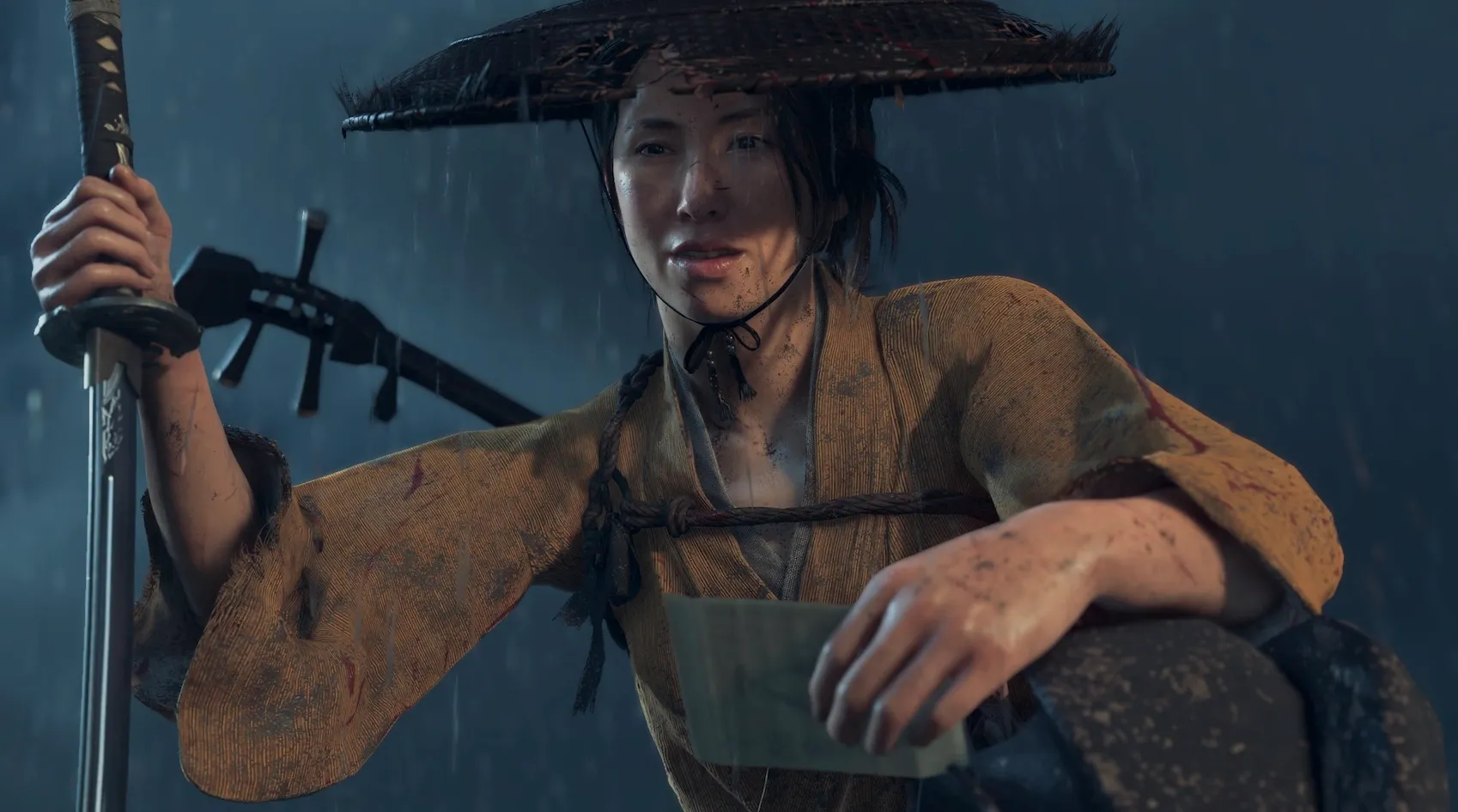
    For Ghost of Yōtei, Atsu could have A LOT of different things on her back: her shamisen, bow and quiver, kusarigama, odachi, or tanegashima (rifle). We thought it’d be cool to give her a little flavor by adding these subtle sounds to the gear based on what was visible at any given time, and again Scream’s scripting and variables allowed us to do this relatively quickly and easily.

    We carried over the dynamic quiver from Tsushima, and then we started with the shamisen. I’d bought a shamisen at a Japanese arts market and we recorded the hell out of it. Josh then built some movement sounds to match our soft, med, and hard paradigm with regards to file lengths and transients. We put it in, and Atsu instantly had a very special, unique character that only the resonance of her shamisen could provide. After that, Chris Walasek designed assets for the remaining weapons and we rigged them up, tweaking the probability so it plays often, but not always in a cadence that matches the animation.

    I love it especially because it’s super subtle so you usually don’t notice it, unless you mute it or turn the gear off on the back. But occasionally the resonance of the shamisen, or the rattle of the kusarigama, or the weight of the odachi pops through the mix just a bit and makes Atsu feel more grounded in the world

    Mixing over time

    Another feature we kept from Tsushima and improved upon was our time-based mixing of foley. Effectively we kept track of how long a player was walking, jogging, or running and would mix down cloth and gear layers over time based on the elapsed time of the action. Once the player stopped moving, or changed speeds, say, from a run to a jog, we reset the clock. The end result was a very subtle means to mix down layers of foley that could grow fatiguing if they continued to play at full volume.

    We also extended this to the hero horse, and would turn down the footsteps, saddle, and bridle sounds over time to provide a transparent means to reduce ear fatigue, especially when galloping across long swaths of the map. This is what that looked like in Scream for a hero gear layer. In this instance the player doesn’t walk very often or for very long, so we opted to only tweak for jog and run.
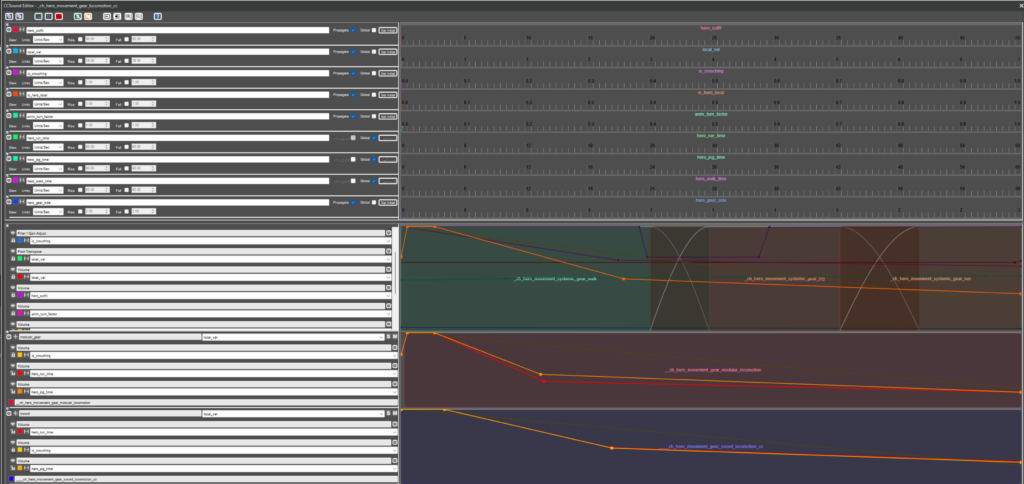
    A view of a sound in Scream with volume curves that attenuate slightly over time based on jog or run time.

    A Very Special Guest

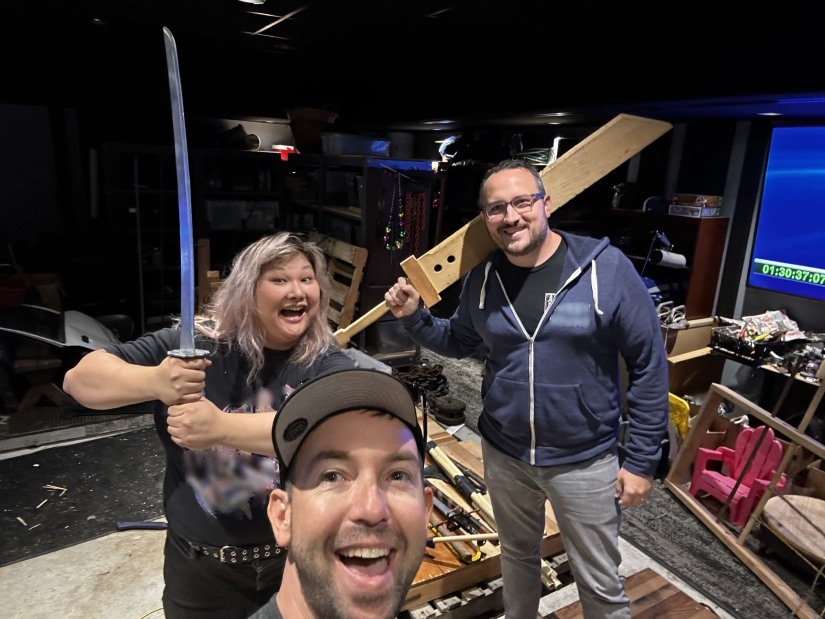
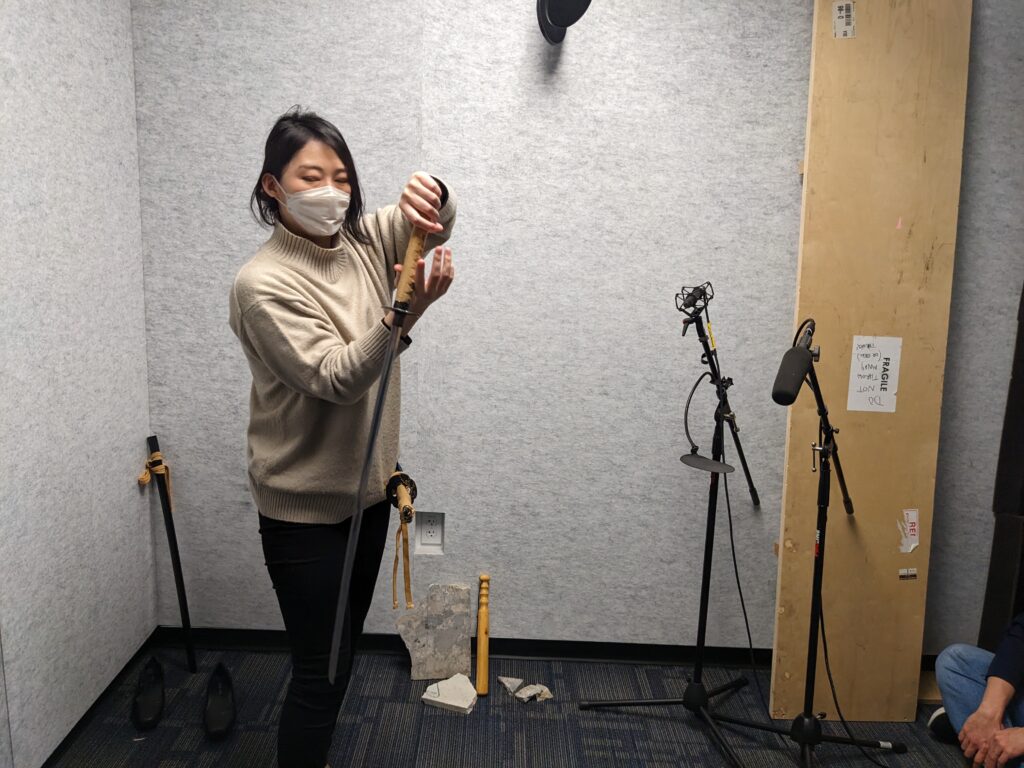
    We were also lucky enough to work with Tenshin-ryu, a school for Japanese swordsmanship in Tokyo. They flew out to Sucker Punch in 2023 and, while most of their time was spent in the mo-cap volume capturing moves for Atsu, I was lucky enough to get some time with Rensei, one of their amazing martial artists. She came into the foley room and we recorded a ton of various swings, sheathing, unsheathing and chiburi (cleaning the blood off the blade) moves. The swings didn’t really work for our needs, but much of the sheathing and unsheathing sounds ended up as elements in Atsu’s sheathing and unsheathing in game. The best part was that Rensei’s swords had a very unique sound to them in that they rattled slightly as she used them, and this helped give Atsu’s katana a very unique sound, while still staying true to real sound of a katana.
    The Glue that Binds

    That covers most of the mechanical features and improvements for Foley in Ghost of Yōtei. The other improvement came in the form of Joanna Fang and Blake Collins, PlayStation’s indomitable Foley team. We worked very closely with Joanna and Blake to capture most of the character foley in game including footsteps, all character gear and foley, combat swings and impacts, and even our horse footsteps, which we concocted from toilet plungers stuffed with cloth and a wood shim taped to the end to give a little clop.

    Here’s a video that may seem rudimentary, but was used to educate the team in a company meeting back in 2023 , fairly early in production of Yōtei (which as you may notice was codenamed “Wanderer” at the time), about what a Foley team does:
  • The Sound Design of Ghost of Yōtei: Ambience

    The Sound Design of Ghost of Yōtei: Ambience

    Ambience is such a crucial part of what makes a Ghost game a Ghost game: it provides a time machine for the player, whisking them back to a believable version of feudal Japan. On both Ghost games, we had Sucker Punch trips to Japan. Although no audio people went on those trips, I always gave a recorder to someone on each trip, and they invariably returned with usable content. In addition, I was able to travel on my own to capture as much natural sound as I could. Over New Years in December and January of 2016/2017 I made a very calculated 10 day trip to Japan to record very specific species for Ghost of Tsushima, and I knew I needed to go back for Ghost of Yо̄tei (poor me).

    Back to Japan

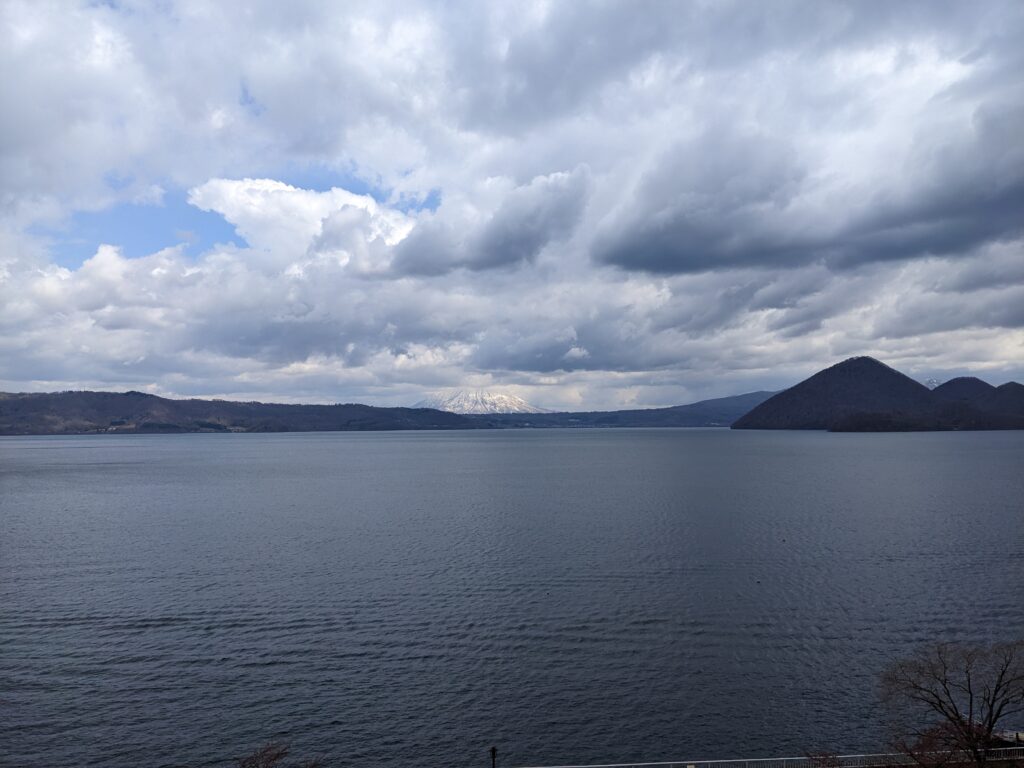
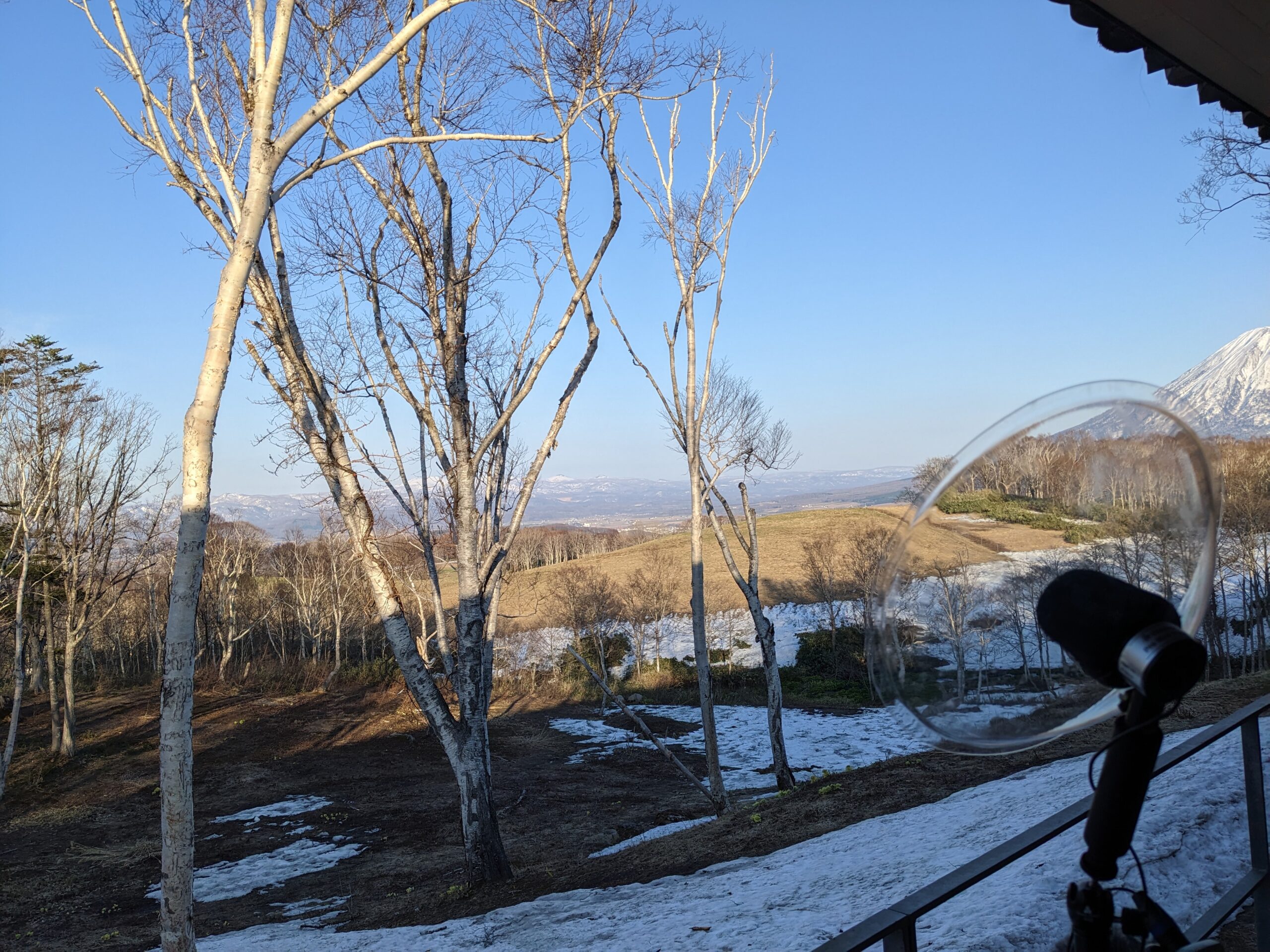
    In April of 2023, I was lucky enough to travel to back to Japan, focusing mostly in Hokkaido, and spent about 10 days traveling around Mount Yotei (seen to the right in the picture above), spending time around Kutchan, Lake Toya, Lake Shikotsu and also spending a day at Noboribetsu, famous for its sulfur pots and the inspiration for Saito’s fortress at the end of the game.

    I wanted to keep my load light, so brought lots of smaller microphones (Usi Pros, Micbooster Pluggys, and a Sennheiser MKH8060), and small parabolic dish, and a Zoom F3 and Sound Devices MixPre6. I went with a few friends, so I would often hike out somewhere for a half day and meet up with them later.

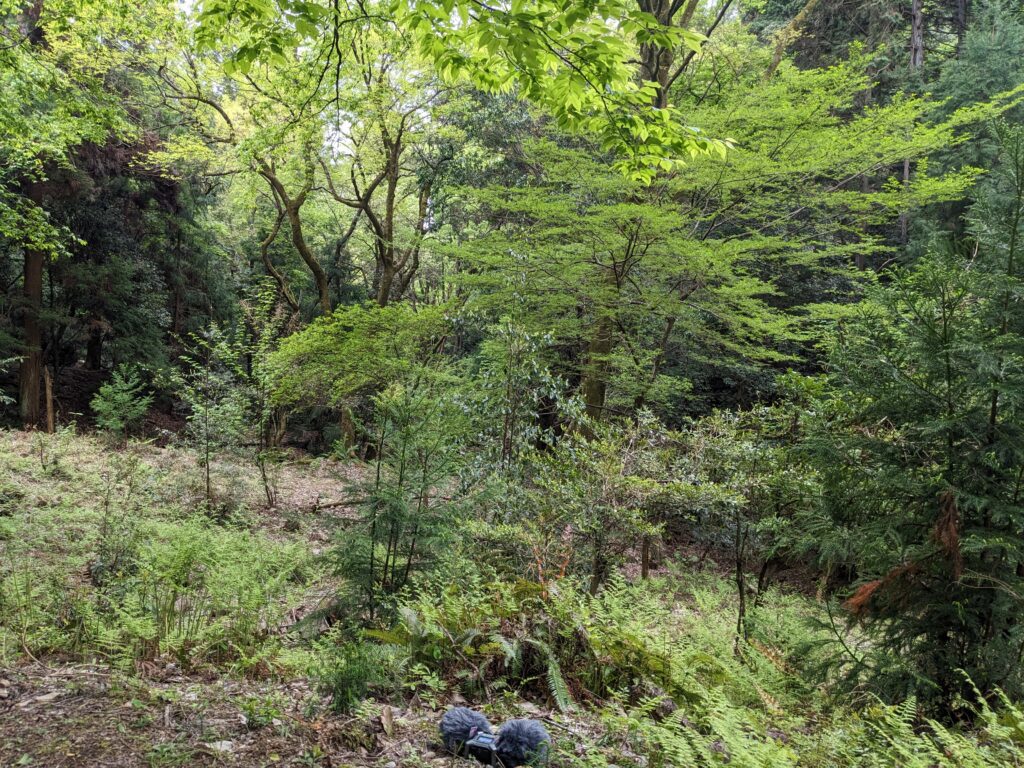
    We also spent a little time in Kyoto and the Seto Inland Sea, so I got a lot of nice recordings there as well. The Japanese Bush Warblers were so prolific around Honshu, I couldn’t believe how frequently I was able to capture that iconic chirp.

    Here’s a recording from Mount Daimonji near Kyoto. Very little processing done beyond cleaning the recording up:

    Hokkaido Bound

    I was fortunate to travel to Hokkaido on my first trip to Japan in 2016, heading over to the eastern side to Kushiro and Lake Kusharo to record red-crowned cranes and whooper swans, and immediately fell in love with the island.

    Lake Toya with Mount Yotei shrouded in clouds in the distance

    Hokkaido is such an amazing place and, other than Sapporo, feels so much more remote than much of Japan, as it’s relatively sparsely populated for its size, and awash in amazing natural beauty. I got so much incredible content on our trip in 2023, that I was able to replace most of our birds from Ghost of Tsushima with wholly new ones. Beyond the Bush Warblers in Hokkaido, one of my favorite species I captured were some Great Woodpeckers (both drumming and calling) around Lake Toya and Kutchan. Here’s some drumming from Kutchan:

    And then there was the Latham’s Snipe. We had just arrived at Lake Toya as the sun was setting. We had what seemed like a nice Air BnB on a hill overlooking the lake. Unfortunately, the house reeked of gas, so as we were airing it out, I set up a recorder on the front deck and this crazy, creepy sound started happening. I had to post it on xeno-canto when I got home just to identify what the heck it was:

    Of course, not everything I recorded was birds, and not everything I recorded ended up in game. In Noboribetsu, a town famous for its sulfuric lakes, I was fortunate enough to record the geyser at Sengen Park, which only goes off every three hours. Super cool sound, but nowhere that really made sense to include it in the game

    recording a steam vent. Sounds cool didn’t end up in the game.

    Sound Scenes

    Beyond our normal biome-based ambience, we also built a new system for Ghost of Yōtei to more procedurally handle smaller-scale ambiences that we previously hand-placed throughout missions and in various locations, like buildings and villages. The contents of these recordings were more akin to the small things in a scene or place that make it feel alive. Distant bells ringing, shoji screens banging, distant barrels rolling, wood dropping, horses neighing, etc.

    Joanna Fang, Blake Collins, and Josh Lord in the Playstation Foley room in San Diego, CA

    We recorded a bunch of source at Sucker Punch and even more down in San Diego with Joanna Fang and Blake Collins. Josh went down and the three of them essentially combed through the foley room grabbing random props and proceeded to shake, slam, drop or bow them to create a huge palette of sounds we could use for our various scenes in the game whether it was a boisterous inn, a bustling village, a ghost town, a rickety bridge, or a weathered shrine climb.

    We then processed the source in three different ways: dry, which was used when the player was near where the sounds would play from, and then a mid distance and far perspective version that used reverb, EQ, and some delay to push the perspective into the distance.

    The system in our engine would then play these sounds back from random positions within volumes that we authored in the game world. So rather than having to hand place dozens or hundreds or emitters. We just dropped a volume and assigned that volume a number of scenes that would play out in the volume based on distance from the listener.

    Our goal with the ambience in Ghost of Yо̄tei was to improve upon the natural audio beauty we built with Ghost of Tsushima, but also provide more dynamic behavior, more movement and more life. I believe we accomplished this, and I cannot express how fortunate I feel to have been able to to travel– twice!– to Japan to not just record nature sounds but breathe in the natural world. Hearing how a space sounds, the natural pauses, the inherent silences, the unexpected tones, coupled with the visuals, the smells, the presence of being in the space is transformative and crucial in trying to really capture the sense of place.

    I love to travel, I love to record, and I truly hope I get to return to Japan again some day and record even more!

  • The Sound Design of Ghost of Tsushima: Bloopers

    No five year long project would be complete without at least a few goofy bloopers. There were so many more that we just didn’t capture, but I hope this brings a smile to your face. For me, it is just a reminder of how lucky we are to do what we do day to day and that we’re able to be creative and have fun for a living is one of the treasures of my life. I feel exceptionally fortunate every day even when (or maybe especially because) I do stupid stuff like some of what you’ll see here:

  • The Sound Design of Ghost of Tsushima: Crafting the Ambience

    To be honest, when we first started making Ghost of Tsushima, I was probably most excited about the possibility of traveling to Japan to capture ambience. We sent two teams over to Tsushima and throughout Japan but I didn’t get to go. It kinda made sense. These were more sight-seeing tours for environment artists, character modelers, and some of the other creative leads to get a sense what Japan was like. If I was going to go I needed isolation, not driving around in a van with 10 other people.

    On the first trip, I gave Billy Harper, our character and animation lead one of my recorders and a brief tutorial on how to use it in hopes he could maybe get away and record some interesting stuff. I wasn’t expecting anything useful but Billy surprised me. He got some usable recordings of birds including some black kites, songbirds, and of course, the ubiquitous jungle crows. The team went to Tsushima and attended the Komodohama festival which commemorates the Mongol invasion landing on Tsushima in 1274. Our team was invited to the junior high school on Tsushima and Billy and our cinematics team recorded several instruments including various taiko drums and a horagai, a conch shell horn that was used by samurai to communicate in battle.

    Being part of Sony, we have a great team at Japan Studio, so we reached out to them and ask if they would be willing to record some ambience for us and they did a great job. The team there drove out near Mount Fuji to capture all sorts of birds in the wild as well as some rivers and wind. They also went to the Kachoen Wild Bird Refuge and got tons of species isolated. One of the sound designers, Ito-san went on vacation to visit family over in Akita prefecture on the Northeastern side of Honshu, the main island of Japan, and got some fantastic recordings of songbirds at dawn and during the say in some rice paddies.

    All of these recordings were great and totally usable, but we were still missing a few specific species of animals we knew were going to be in the game, so I decided fairly last minute to spend my Christmas and New Years traveling around Japan on a whirlwind trip chasing after more specific species. My partner, Bonnie, joined me as travel partner and documentarian. I had planned a 10 day trip for us. We would land in Tokyo one evening, then fly out to Hokkaido the following morning, record the tancho (the red-crowned cranes), travel to Lake Kasharro to record the Whooper Swans, then back to Honshu. We’d spend New Years in Tokyo, then head up to Nikko, followed by a trip into Nagano prefecture to try and record the snow monkeys.

    The entire trip was absolutely incredible. Japan is insanely beautiful, the people exceptionally friendly, even when there’s a language barrier, and the food was always fresh and amazing. The entire trip was a highlight, but also included some fun surprises. When we were in Nikko, we checked out the temples as you do, but then hiked up a mountain near the Kirifuri Ice Arena. I set up my recorder to capture some ambience and walk a little ways away. A short while later we were startled by what sounded like a piercing alarm chip. It happened again and then once more. Bonnie and I looked at each other and mouthed “What the fuck was that?” Suddenly we saw two huge sika deer run by in the valley below us. The continue to chirp their alert calls for the next 10 minutes. Those recordings feature prominently in Ghost of Tsushima.

    There were some other cool moments that didn’t make it into the game as well. In Kushiro on Hokkaido, the Kushiro River was half frozen with large sheets of ice flowing down the river and crashing into each other. One night I threw my hydrophone into the river, hoping to get some interesting underwater sounds of ice creaking, crunching and colliding, but there was nothing quite so interesting.

    After compiling all this great content from so many people, I made a movie to share with the team as part of one of our team meetings. My attempt to evoke David Attenborough is pathetic, but the video was a fun glimpse into just how global the effort was to capture realistic and accurate ambience for the game.

  • The Sound Design of Ghost of Tsushima: Fake Birds

    The natural world we built for Ghost of Tsushima is one of the sonic highlights for me. The world is lush and full of so many different species of birds, insects, amphibians and mammals, many of which were recorded in Japan and most of which are native to Japan. It really creates this wondrous natural beauty for the rest of the game to sit on top of.

    We had our friends at Japan Studio in Tokyo record a lot of ambience for us and I was fortunate enough to travel around Japan for a couple weeks and capture all sorts of wildlife. The ambience was one of the more time consuming systems in the game, but it was also one of the first to get solidified. We had good variety of wildlife species and the world felt rich, but as I explain in the video below, getting towards the end of the project they decided to add a few new specific species. We didn’t have time or resources to fly halfway around the world and try to track these specific birds down, nor could I find a library with them.

    Fortunately, the Slack field recording channel was doing a bird crowdsource around this time, and while discussing our recordings, Alex Barnhart asked if anyone had tried pitching down real bird recordings, performing them, and then pitching them back up to see if you could replicate birdsong in that way. We all thought it sounded fun and cool and it was very shortly after this moment, that they decided to add 3 new species to the game, so I took this knowledge and went for it.

    I went onto xeno-canto.org which is a fantastic website for information and birdsong and found some decent quality samples that I could use as reference. From there I tried pitching them down to various ranges from an octave to four octaves and everywhere in between, trying to find that sweet spot where it was in my vocal range and performable. After performing, and looking and sounding appropriately goofy, I was pretty surprised and pleased when playbacking the results. Once I put them in game, I knew this was going to work!

    They even added a couple more species (a cormorant and a Eurasian sparrowhawk) that I was able to perform adequately. The one place I failed was when trying to augment our existing Black-naped oriole recordings. This is a really important bird in the game, as he guides you to your various objectives. I had captured one while recording in Sri Lanka, but my recordings were limited, so I hoped to bolster our content with some faked versions, but when playing a fake bird against a real bird, it becomes VERY evident which one is fake, so I abandoned it.

    The results were so surprisingly decent, we played a game at work where the team listened to bird samples and tried to identify whether they were a real bird or me, and it was hard. Even I got half of them wrong! So here’s a video that goes into more of these details and also shows the process in action:

  • The Sound Design of Ghost of Tsushima: Horses

    One of the first decisions made on Ghost of Tsushima was that our main means of fast locomotion in the game would be horses. It made sense since that was what was used by both Mongols and Japanese warriors in the 13th century. There would be no grinding power lines or zipping through air vents or beaming from one radar dish to another. So of course we knew the horses needed to sound great.

    Surprisingly I think the only other game I’ve worked on that almost had a horse was a Shrek game that got canceled. In that game in a very on-the-nose homage to Monty Python, there were knight enemies that rode around on hobby horses. For the knights footsteps I recorded coconuts and the results were as hilarious as intended. So for fun, when we first got the horse working in game, I re-recorded the same coconut shells and, while still hilarious, it didn’t quite fit tonally.

    We began to research some places to record horses. The most important thing was we needed shoeless horses. While there was conflicting information about whether or not Mongols shoed their horses, we could find no information demonstrating the Japanese shoed their horses with metal, so we opted to keep things simpler and go for natural footsteps. After calling some places that fit the bill and driving around to check out their properties, assess noise levels, etc., we decided upon the Northwest Natural Horsemanship Center out in Fall City, WA. The owner Jim Hutchins, was keen to work with us and seemed genuinely interested in our work.

    Unfortunately between the time we agreed to record there and the date of the recording, my sound designer had left for another position, so I was on my own for the session. One fewer person to operate microphones posed some problems, so I got creative: I followed the horse with a boom mic and strapped a recorder and a pair of omni electret condenser mics (a Roland CS-10EM) to the saddle which we taped down (and taped all buckles on the saddle).

    Horses are amazing animals and when the horse first saw my furry blimp, it was not happy. We got lots of great nervous vocalizations which ended up as the final assets in the game as it got used to the presence of the blimp. From there Jim guided the horse around on various surfaces in their property (grass, tall grass, dirt, mud, wood, gravel, stone/concrete, and asphalt) at trot, canter and occasionally gallop speeds and I chased after them with my mic. We got A LOT of horse grazing because when a horse is hungry and has the lay of the land, they eat when they feel like it. These assets too were eventually massaged by Erik Buensuceso and made it into the game. In fact, the amount of grazing sounds we got and the frequency with which the horses naturally ate grass was the impetus for us adding the grazing animations into the game!

    To get bigger whinnies and neighs, Jim put two of the horses together who were really good friends, and then separated them. Once one was led far enough away, the other would bellow out a very loud call for their friend. I inadvertently recorded a horse fart at one point, but was too far away so unfortunately it was not usable. Lastly, we went into their gear barn and recorded a bunch of sounds of various bridles and saddles, again taping down any metal parts since we wanted to avoid jangling components in the sound design.

    Once I chopped up the assets and integrated them into the game I made this delightfully silly video to show at a company meeting:

    But we were still a long way from being done. The horse had to sound great because it was used SO much in the game and we wanted to really push on the detail of everything about the horse from its footsteps to its saddle and bridle sounds to its vocalizations. I think when all was said and done the assets for the horse were probably touched by almost every sound designer on the project. I can think of at least 5 of us that did some work on the horse, tuning and improving and iterating to make them sound great.

    On the mix side, Josh came up with a great idea we used on both hero and horse foley. We created an RTPC that tracked how long the player was running or the horse was galloping, which we used to subtle mix down the non-footstep sounds after 10-15 seconds. This served the purpose of helping reduce ear fatigue and allow other sounds to cut through the mix on long traversals. With this attention to detail we got some really nice dynamic behavior in the sounds in game.

  • The Sound Design of Ghost of Tsushima: Dogs

    The dogs in Ghost of Tsushima are fun to talk about because, like so much of the soundscape of the game, we started with a lot of research and then recording them was a blast. Let’s just ignore the fact that Jin kills so many dogs in his journey and rewind a few years when we first started talking about having dogs in the game. The impetus for adding dogs was to have a unique enemy type that was also more adept at hunting Jin than the Mongols. Like everything else in the game, we did a bunch of research and found that Mongols did indeed use dogs and that from Genghis Khan on, their dogs were ancestors of the breed now known as the Tibetan Mastiff (which technically is not a mastiff, but I’m not here to get into a discussion about dog breeds). So the art team began working on models of Tibetan mastiffs, which meant we needed to find some sounds for them! We started looking online and these dogs looked and sounded fierce, but also fairly unique. So I started looking to see if there were any Tibetan Mastiff breeders in the area and I struck gold: there were actually a handful within a few hour drive from Seattle!

    We ended up connecting with Debbie Parsons of Dreamcatcher Mastiffs. She mentioned they had several Tibetan Mastiffs and we were welcome to come record them. So Josh and I packed up our mics and recorders and headed out to Graham, WA, just an hour south of Seattle on the way to Mount Rainier. As soon as we showed up, we were greeted by 3 VERY large, scary and seemlingly angry dogs. We started recording immediately and got some terrific barks and growls (unfortunately interspersed with chain link fence rattle as they were pretty excited). Debbie was super helpful and started taking most of the dogs inside and allowing us to record each one individually. We got a good range of growls, snarls and barks. Debbie even ended up putting on a hooded sweatshirt and acting like a prowler to get them riled up. After getting all these great barks, we went into the property to record more and these dogs transformed into the cuddliest, sweetest bears (seriously they looked like bears in dog suits).

    We were able to get panting and breathing and even chewing on bones as they had settled down and got used to us. From there Josh took the recordings, cleaned them up and got them in game. Rob Castro did a final polish pass towards the end of the project to make them even more terrifying. As you can hear from this video we created for a company meeting, the were already pretty scary before the sonic magic was applied.

  • The Sound Design of Ghost of Tsushima: Combat Impacts

    We knew as soon as we began working on Ghost of Tsushima that swordplay would be a major part of the game and that the swords had to sound dangerous. We had been working on some close quarters sword-based combat prototypes and in moving to the world of feudal Japan, we wanted to approach combat from a grounded perspective but also really make the sound of the swords slicing through enemies feel razor like. Lots of games and films go for a really meaty, thuddy impact to make things feel powerful. We wanted to go against this trend and make our swords SOUND sharp.

    To do this, we really focused our impact sounds on elements of slicing rather than hard impacts. But of course it took a lot of experimentation and a lot of recording. Josh Lord (our senior sound designer) and I amassed a collection of various blades and other sharp objects and applied them to myriad fruits and vegetables. There were some surprising results: digging into celery with the tip of a knife sounding like cutting through bone; a razor blade through an onion sounded like a gut being opened; a serrated bread knife created interesting zippered slicing tears.

    Once we got all this source material together, we started experimenting with integration techniques, adapting a technique utilizing sound states in Wwise tied to our animations to trigger different impacts based on animation data. Towards the end of the project, we passed off our combat sounds to Mike Niederquell from Sony for some final polish and for him to work the magic he does. We ended up abandoning our state-based multi-impact approach and Mike made bespoke content from our recordings for the various impact types as the animations weren’t so excessive, and the state rigging introduced unnecessary complexity.

    Here’s a short video of some of the props that sacrificed themselves for the greater combat good as well as how they ended up sounding in game:

  • The Sound Design of Ghost of Tsushima: the Mongol Warhorn

    A sound we knew we needed early on was a war horn for the Mongols. It had to be iconic and immediately recognizable so that a player could hear it nearby or in the distance and know “uh oh, there are Mongols nearby, and they may already know about me.”

    In researching both samurai and Mongols we found many musical instruments used by Samurai to both communicate on the battlefield and attempt to instill fear in their opponents. We were fortunate enough to record some of these instruments including the horagai, a conch shell horn, at Komodahama during their yearly festival commemorating the first Mongol invasion of 1274. In all the research we did on the Mongols, however, I couldn’t find much in the way of music used for war purposes. Most of their music practices were either for celebrations such as marriage, played at imperial court, or just to pass the time. The Mongols were a nomadic people and while their main instruments were stringed instruments like the morin khuur they did also have horns, including some that were made of either wood or animal horn.

    With all that knowledge, but a lack of access to traditional instruments, we opted to take some liberty in crafting a sound that we could tie to the Mongols, and would sound unique from the samurai horagai. In their native lands (and by extension the lands they conquered throughout China and the Korean peninsula) the Mongols used several domestic animals for food and drink. The horse was the most important delivering them everything from transportation to alcohol (airag, also known as kumis, is fermented horse milk), but they did also use yaks and cattle. Using this as a jumping off point, I found some steer horns and purchased one, hoping I could teach myself to blow through it and that it would make a sound unique from the conch shell. Fortunately it didn’t take long for the gasping breaths and pushed air to turn tonal and we recorded a bunch of variations on the war horns. We experimented with different calls to signify different enemy states, but in the end we opted to use it for a simpler enemy alert.

    We processed the recordings to provide greater reflection and distance modeling the further away you go, and so we could fire off closer or more distant variants depending on what the in-game action called for. Here’s a short clip of recording some of those horns and then what they sounded like in-game:

  • Wwise Tour 2020: Sonic Storytelling

    I finally updated my website’s backend after being on PHP v5.6 (current version is something like 7.4) for far too long. Good news is now you can access the site via https for better security. Now that that is done I hope to post some articles soon about some of the specific sound design and recording we did on Ghost of Tsushima.

    For now, here’s a talk we did in December about Sonic Storytelling and exploring some of the ways we use audio to tell our stories. It was a lot of fun to share some of the world with the audio community: